
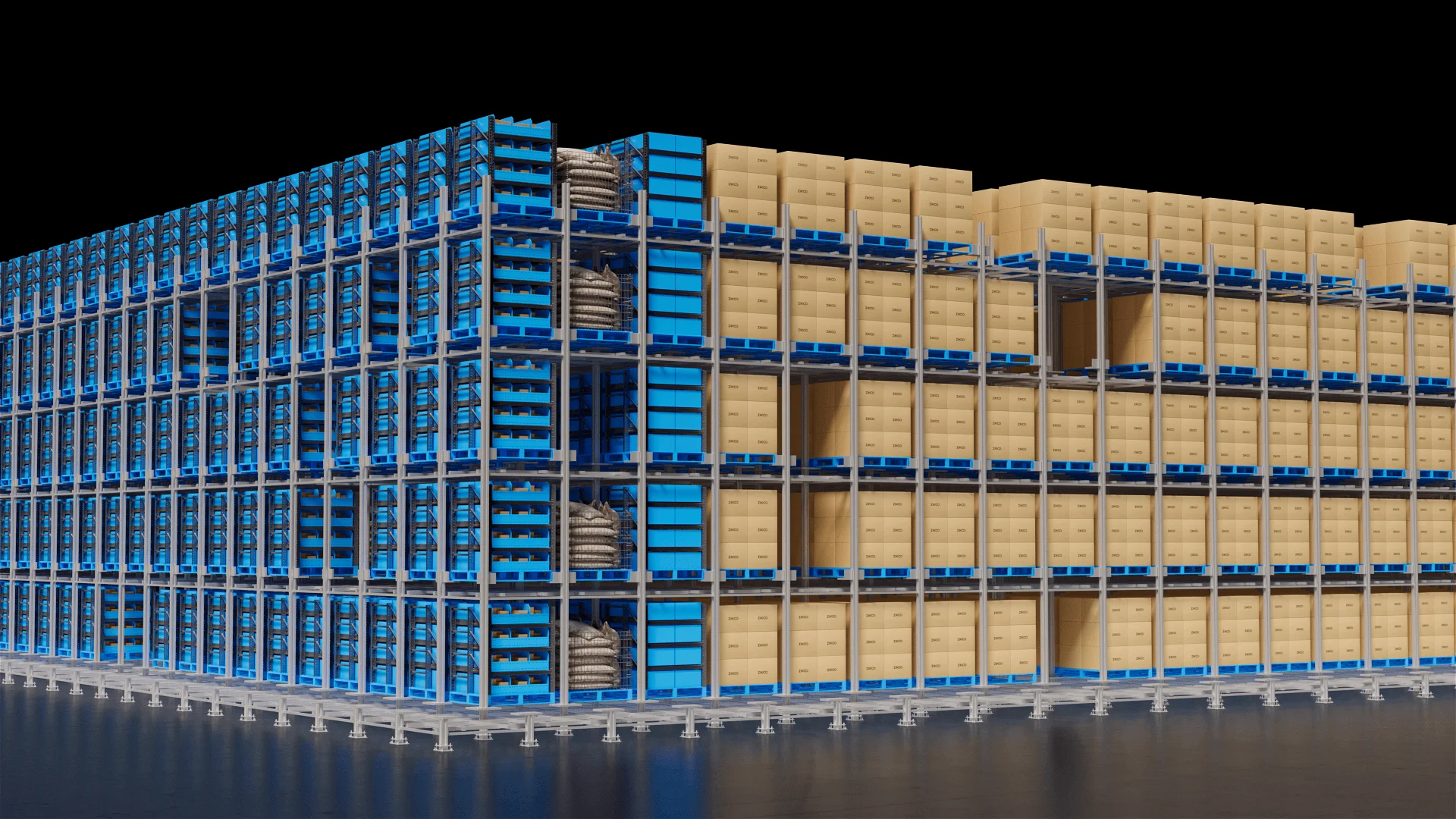
As global supply chains become increasingly complex and customer expectations for faster delivery continue rising, warehouse operations are under greater pressure than ever before. Traditional warehousing methods that rely heavily on manual labor, overtime shifts, or warehouse expansion are no longer sufficient to meet modern logistics demands.
Today, companies are turning to robotics and Intelligent Warehouse automation to improve operational efficiency, reduce costs, and build more scalable supply chain systems. By combining advanced software platforms with automated storage technologies, businesses can create highly efficient and flexible warehouse environments capable of adapting to rapid market changes.
Why Warehouse Optimization Is More Important Than Ever
Modern warehouses face several major operational challenges:
- Rising labor costs
- Increasing order volumes
- More complex SKU management
- Faster delivery requirements
- Limited warehouse space
- Seasonal demand fluctuations
In traditional warehouse environments, manual processes often create bottlenecks that slow down order fulfillment and increase operational errors. Expanding warehouse space is expensive, while recruiting and retaining labor has become increasingly difficult in many regions.
As a result, Intelligent Warehouse automation is becoming a critical strategy for companies seeking long-term operational efficiency and competitive advantage.
The Foundation of Smart Warehouse Systems
A modern smart warehouse depends on close coordination between software systems and automated equipment. Most advanced warehouse automation platforms consist of several integrated control layers:
WMS (Warehouse Management System)
The WMS manages:
- Inventory control
- Order processing
- Storage allocation
- Warehouse planning
WES (Warehouse Execution System)
The WES optimizes:
- Workflow execution
- Task coordination
- Order prioritization
- Operational balancing
WCS (Warehouse Control System)
The WCS controls warehouse equipment in real time, including:
- Conveyors
- Shuttle robots
- Elevators
- Stacker systems
- Sorting equipment
When these systems work together, warehouses can achieve highly efficient, data-driven operations with improved accuracy and throughput.
ZIKOO Robotics integrates WMS, WES, WCS, and RCS functionalities into its PTP Smart Warehouse Software platform, creating seamless coordination between software management and automation equipment.
How Robotics Improve Warehouse Efficiency
Warehouse robotics play a critical role in reducing manual labor and improving operational consistency.
Unlike human workers, automated systems can operate continuously with stable performance and high accuracy, making them ideal for repetitive warehouse tasks such as:
- Pallet transportation
- Storage retrieval
- Material handling
- Picking operations
- Inventory movement
Automation not only reduces labor dependency but also helps improve:
- Picking accuracy
- Warehouse throughput
- Inventory visibility
- Operational safety
- Order processing speed
These benefits directly contribute to lower operating costs and stronger supply chain reliability.
Maximizing Dense Storage with Automated Warehouse Systems
Warehouse space utilization has become a major factor in logistics efficiency, particularly in regions with high industrial land costs.
Automated Storage and Retrieval Systems (ASRS) help businesses maximize both vertical and horizontal warehouse space through high-density storage design.
Advanced shuttle technologies allow goods to move efficiently throughout multi-level warehouse structures while minimizing aisle space requirements.
ZIKOO’s Six-Way Shuttle solution combines:
- R-Bot Four-Way Shuttle systems
- H-Bot vertical transfer technology
This integrated system enables intelligent six-directional movement, creating a highly flexible Automatic 3D warehouse environment optimized for Dense Storage applications.
The modular design also allows businesses to scale warehouse capacity gradually as operational demand increases.
Pallet-to-Person Robotics for Faster Order Fulfillment
One of the most effective warehouse optimization strategies is the pallet-to-person automation model.
In traditional warehouse operations, employees spend a significant amount of time walking between storage locations to retrieve products. Pallet-to-person systems eliminate this inefficiency by automatically transporting inventory directly to operators.
ZIKOO Robotics provides advanced pallet-to-person solutions through its U-Bot omnidirectional stacker robots and intelligent shuttle systems.
These robotics technologies help:
- Reduce operator travel distance
- Improve picking productivity
- Increase order accuracy
- Lower labor intensity
- Accelerate order fulfillment speed
The result is a more efficient and scalable warehouse operation capable of supporting high-frequency logistics environments.
Important Factors Before Implementing Warehouse Automation
Successful warehouse automation projects require strategic planning and careful system evaluation.
Before implementation, companies should assess:
- Existing software compatibility
- Facility layout and warehouse structure
- Required throughput capacity
- Product and pallet characteristics
- Safety requirements
- Long-term scalability needs
In many cases, phased deployment strategies offer the best approach, allowing businesses to gradually introduce automation while minimizing operational disruption.
Building Smarter Warehouses with ZIKOO Robotics
As an innovative provider of Intelligent Warehouse automation solutions, ZIKOO Robotics delivers integrated robotics systems and smart warehouse software designed for modern logistics operations.
Its PTP Smart Warehouse platform combines:
- WMS
- WES
- WCS
- RCS
- U-Bot stacker robots
- R-Bot shuttle systems
- H-Bot vertical transfer technology
Together, these technologies enable:
- Higher warehouse efficiency
- Better Dense Storage utilization
- Faster order fulfillment
- Reduced operational costs
- Flexible future scalability
The Future of Intelligent Warehouse Optimization
Warehouse optimization is no longer simply about increasing labor or expanding warehouse size. Modern logistics competitiveness depends on intelligent automation, real-time system coordination, and scalable warehouse design.
By integrating robotics, smart software, and Automatic 3D warehouse technologies, businesses can create more efficient, flexible, and sustainable warehouse operations capable of adapting to future supply chain challenges.
As global logistics continues evolving, Intelligent Warehouse automation will remain one of the most important drivers of operational performance and long-term business growth.
